Wednesday, April 21, 2010

Egypt: from Cairo to Hurghada

We left sub-Saharan Africa by plane, flying from Kenya to Cairo with a stop in Addis Ababa, Ethiopia and a touchdown in Khartoum, Sudan. Cairo is a massive city,of 20 million people and traffic, noise and pollution to match. A clean air day in Cairo is worst than any of the worst dangerous ozone days in the states. It feels nothing like the Africa we left in Uganda and Kenya. Egypt is overwhelmingly Muslim (90%) and has become more conservative over the past 10 years. Most women at a minimum cover their heads, and many wear the full abeyya (black robe with head covering and only their eyes showing through a slit in the fabrc.) The Egyptian past is the history of the world’s civilization and has intricate overlapping civilizations melding and conquering each other. Its history starts in 4000 BC with the ancient Egyptian dynasties and the unification of lower and upper Egypt. It is followed by Roman and Greek history, the Mamluks (Turkish slave-soldiers), Chrisitians and Muslims the 7th century AD. Today Egypt is a modern country that is vibrant, alive with tourists and comerce. It has many problems, including a faltering economy and high unemployment, overpopulation, dissatisfaction with a longstanding regime, and tension between extreme Islamists and moderate muslims, but vibrant and alive with modern commerce and tourism.

We spent 5 days in Cairo, basing ourselves from our very budget hotel in the middle of downtown and explored from there. Cairo is most alive from the late afternoon until 3 or 4 in the morning and at night the city is so bright with street and store lights that most drivers don’t bother to use their lights. The traffic is thick and constant and despite traffic officers on most corners, cars keep coming and pedestrians play a game of frogger to get across. Luckily our time in Uganda prepared us for dodging cars. Everyone in Egypt smokes, all the time, and the most popular pastimes seem to be sitting and drinking tea or coffee and smoking sheesha, flavored tobacco smoked through a water pipe. We joked that you can sit down on any stoop, anywhere, and out of nowhere someone will run over to offer you coffee or tea. Men and women lead pretty separate lives and women do not hang out in the coffee shops.Most women are covered up, some so much so that they wear gloves and even a veil covering over the eye hole of the abeyya (head covering). The majority of the clothes stores however, have store windows with tight Western outfits, miniskirts, tank tops, leggings and very scandalous lingerie, all displayed next to conservative traditional black robes and head scarves. At first we thought the Western clothes were for tourists, but they are not: they are for these same women who can’t show an inch of skin outside the home but under those black robes, let me tell you, they are wearing some sexy underthings for their husbands!

Being the two voracious eaters that we are, we really enjoyed the food in Egypt in general, and especially Cairo after the long stint of bland African food. We found that the best food was always at small, hole-in-the-wall places that were down little alleyways and definetly not in the Lonely Planet. We ate a lot of ta’amiyya (like falafel but made from fava beans), baba ghanoush, tahina, flash fried mini eggplants and peppers. We tried fuul (mashed fava beans, tastes a bit like refried beans) which is the national food and koshary (rice and pasta mixed with garbanzo beans, fried onions, lentils and a vinegar-tomato sauce) both of which are very popular for being filling and cheap (50 cents for a meal). All the meat is delicious and grilled over open coals. In Cairo, we drank our weight in fresh juices that are literally the entire fruit pulped in front of you into a glass: sugar cane, mango, orange, carrot, strawberry, melon. We also ate our weight in desserts that Egypt is famous for, most of them fried or filo dough seeped in rose-water honey. Every meal was preceded and post-scripted with a Turkish coffee, thick grounds boiled with sugar and cardamom that is drunk in a shot glass. On almost every street corner there is a metal water cooler that dispenses cool water that is free and cups are provided—the water in Cairo was fine to drink, if a little too chlorinated, and it was so nice not to have to search for and horde water in bottles. Arab hospitality permeates the culture, and we heard that these coolers are often donated by wealthy families as a gesture and to help prevent dehydration,

We saw some of the usual sights: In Cairo we visited the Egyptian museum, a disorganized but ridiculously extensive collection of ancient Egyptian treasures, statues, sarcophagi (tombs) and mummies. The ancient Egyptians fine-tuned mummification and even kept their pets as mummies after they died. We spent a day at Giza, visiting the pyramids and the Sphinx. Giza is a suburb of Cairo, about 15 km south of the city, and the pyramids are a small island in the middle of cars, apartment complexes, businesses and all the pollution of Cairo. The pyramids are impressive and starkly beautiful, and the desert beyond them is vast and hot and flat. There are 3 of them and 4000 years has done little to chip away at them, although a mamluk Sultan in the 1100s tried for 8 months to destroy the smallest one, it only resulted in a tiny defect in one side. The touts that Egypt is famous for were in full-force at Giza, and we were assaulted by people trying to get us to ride their camels and donkeys, buy stone models of pyramids and scarabs, take a tour with them, take their taxi. They come at you from every side, “You want camel? You know how much? Very cheap. Come on, take my camel. Why you want to walk?” Many forceful La, Shukran (no-thank you’s) are needed to fight them off, only to run into another one a few yards away. Such was our experience in Egypt in general, and frankly the only thing that was difficult about being here. The touts are everywhere on the tourist track, offering felucca boat rides on the Nile, carriage rides, spices, alabaster Sphnixes, taxis, tee-shirts, belly dancing costumes, sandals….pretty much anything your average tourist needs, really.

The rest of our time in Cairo was spent touring different parts of the massive city. In Islamic Cairo we spent a day walking through old alleyways, and visiting some of the 100s of mosques, including the oldest mosque in Egypt, meandering through the famous Khan al-Khalili souq (market), seeing the gates of the old walled Muslim city of Al-Qahira, that became Cairo. We spent a day in Old Cairo which houses Cairo’s Coptic (Egyptian Christian) community, (10% of the population is Christian and the Copts were in Egypt before the Muslims took over) and the oldest and one of the only synagogues left in Egypt. We strolled along the Nile, had coffee and sheesha and played shesh-besh (Backgammon), got lost in neighborhoods, ate and ate again and walked miles through masses of people and cars. I even went for a run along the Nile one morning and quickly realized that this is decidedly not something that people do here, especially women. We both really enjoyed Cairo, despite its reputation for hassle, and found people to be friendly and welcoming and warm.

From Cairo, we took a very uncomfortable overnight train ride along the Nile valley south to Luxor where we spent 2 days seeing the Temples of Karnak and Luxor and the Valley of the Kings. Luxor is the ancient city of Thebes, famous during ancient Egypt’s Middle Kingdom and the monuments were amazing. Sleep-deprived, we set out for the Temple of Karnak, a massive complex that was expanded upon by several centuries-worth of pharaohs and now encompasses over 2 square km of columns and pylons (entryways to temples) and obelisks and statues and walls covered in hieroglyphics singing the praises of the pharaohs and gods. Luxor had a worse problem with touts than Cairo and we were more aware of the masses of tourists, groups of Eastern Europeans in inappropriate scanty clothing, Asians in hospital masks, Egyptian school groups, package deals through resorts, backpackers such as ourselves. Of course the guards in every part of the temple were on hand, offering to show us a “secret” part of the temple for a baksheesh. Baksheesh is a social lubricant in the Arab world, its how business and relationships happen, and its basically a little tip to help get things done and has been bastardized for tourists to the point where people will put their hand out after doing small things like opening doors, putting your backpack underneath the bus, giving you directions, or sometimes nothing at all.

Our second day in Luxor was spent on the west bank of the Nile at the Valley of the Kings. We took the people’s ferry over and rented bikes that we used to get 8 km into the desert hillside that houses the tombs of some of the most famous pharaohs and nobles and queens of ancient Egypt. We got to see 3 of the tombs, massive tunnels dug deep into the rock, leading to burial chambers. The walls of the tombs are decorated with drawings and hieroglyphics, detailing the instructions for the pharaohs to reach the afterlife. Many of the drawings still have the original color from thousands of years ago and although none of the treasure or mummies remain in the tombs (they were stolen by tomb raiders or are housed in various museums) the enormity of each project and the beauty of the art was humbling. We visited the Temple of Hatsehpsut, built into the rock, honoring one of the 6 female pharaohs to rule ancient Egypt and the Colossi of Memnon, 2 massive statues that guarded what is now thought to be the largest temple to any pharaoh that ever stood, but is now a ruin. The Collosi are covered with Roman graffiti, a reminder that tourists have been coming here for thousands of years to see Thebe's sites.All throughout, we barely scratched the surface of what there was to see and do. It seems that anywhere they dug in this Nile valley they found remains of ancient civilization.

We left Luxor on a bus for the Eastern coast on the Red Sea, a town called Hurghada where we were to catch a ferry that would take us to the Sinai peninsula where we would continue our Egypt adventure.


For the Picasa web album of Cairo and other pictures, click here.

Thursday, April 8, 2010

Kenya


We made a change in our itinerary and decided to stop in Kenya for a week seeing as we had airline ticket vouchers to use from the Tanzania forgotten tickets incident. We flew from Kampala to Nairobi and timed our visit, lucky enough, to meet up with our friend Sarah Judkins who also happened to be in Kenya. Marc Bloch, a friend who lives and works in Nairobi coordinating the east African efforts of Caritas, a swiss NGO, helped us organize a cheap hotel in a nice part of town, and helped make a big city much smaller and more manageable. Our intentions were to climb Mt Kenya, the second highest mountain in Africa and we were feeling pumped up from our big climb in the Rwenzoris several weeks before.


Mt Kenya is, like most east African summits, a massive extinct volcano. It is a mountaineer’s mountain with the possibility of multi-pitch technical rock and ice climbs on massive granite pillars and walls. Since we had no gear, we chose to climb the highest non-technical peak: Point Lenana. We made arrangements in Nairobi with porters and a guide, Dickson. We were to hike the Sirimon-Chogoria route. The route starts on the northwest side of the mountain, climbs up to the summit circuit, over Lenana point and down the eastern flank. The hike is supposed to take about 4 days and covers about 10-32 kilometers per day.


The trail meandered through varying ecosystems and alpine zones as we ascended into the clouds. We stayed at huts each night and, although we were blessed with very good weather, given that it is the rainy season, we were glad to have the shelter most afternoons when it dumped rain while we stayed dry inside. After spending our first night at Old Moses camp (3200 meters), we trekked through a beautiful glacial valley, meeting up again with some of the pre-historic flora that we encountered in the Rwenzori Mountains. That afternoon we arrived at Shipton’s Camp (4200 m), the staging ground for Pt Lenana. The camp, set at the base of the glaciers and high peaks of Mt Kenya, afforded gorgeous views of the summits when the clouds cleared, and we got a chance to gawk at the monster walls of the mountain’s peak who’s highest point clocks in at over 17,000 feet and involves a 2-day technical rock/ice climb to reach. Our more modest goal was Pt Lenana, at 4985 meters (16,300 feet) and we were hoping for a clear night with no rain as our ascent was to start at 4 am the next morning.

Our wish came true and we awoke to a clear and star filled sky. Huffing up under shooting stars, we jammed up Point Lenana with our guide Dickson and one of the porters, Abu. The hike took us through scree fields, crystalline ice, and rocky scrambling and couloirs. We reached the top just as the sun was rising in the east for stunning 360-degree views of the mountain landscape. On a clear day, it is possible to see Mt Kilimanjaro (250 km away?), but we were not so lucky. We spent a bit on the top to celebrate and take pictures and then got out of the freezing wind and descended almost 8000 feet over the course of the day through still mountain tarns and along the rim of a massive glacial gorge, the largest in East Africa. The landscape on east side of the mountain was dramatic and pristine and the valley below opened up into vast green hills. The day’s end brought us to the park edge at 2700 meters and we spent the night at the simple Mt Kenya Lodge, complete with a fireplace. Our guide Dickson and Guy went foraging for stinging nettles, a Kukuyu treat, and Dickson taught us to cook them and had us drink the broth (to strengthen the joints for the next day’s descent).

Our last day was a massive downhill slog on a jeep road through rainforest that covered about 20 miles. The forest is home to tons of wildlife and we saw buffalo, monkeys and evidence (very fresh poop and massive footprints) of mountain elephants, hyenas, jackals and duikers. With sore legs and many tsetse fly bites we made it down to the town of Chogoria where we spent a night in a too local hotel and caught a matatu back to Nairobi the following day.

Because the mountain took less then we thought we had 4 days to kill in Nairobi before our flight to Egypt. We celebrated Sarah’s birthday with a tasty Italian dinner and saw her off to her adventure at Tenwick Hospital in Western Kenya. We spent time in coffee shops, playing on the internet and catching up on errands. We had the privilege of attending the Passover seder with the Kenyan Jewish community that is made up of a whole mish-mash of members, Israelis, Expats, and Jews whose families have been in Kenya since the early 20th century, many of whom came in anticipation of the formation of the state of Israel in east Africa, as was almost the case. When this didn’t materialize, they stayed.

In all we spent 10 days in Kenya. The thing that struck us most about the time there was how different Nairobi (and even rural Kenya) is from Uganda. Nairobi is big, cosmopolitan, modern, and developed with a diverse population and despite having the reputation of being the most crime-ridden city in Africa, we found it safe. While there remains plenty of economic, political and social problems in Kenya such as rigged elections, crime, and tribalism, Kenya appears developed, people seem purposeful, more educated, and more worldly then its neighbor to the west. The roads were paved, commerce ticking, and industry seemed everywhere. Electricity reached deep into rural areas, and there was an overall feeling of more order and less chaos. There were noticeably less children, even in rural areas, no hordes of naked babies running everywhere. As mzungus we were not as much of a novelty, but we didn’t get to witness slum life as intimately as we did in Uganda. We both agree that we feel lucky we got to spend time in Uganda, a county that feels like it is more in the throes of development then more established Kenya.

We are now in Egypt, making our way up the Nile from Cairo to Luxor, then to Hurghada on the Red Sea and by ferry to the Sinai Peninsula. Stay tuned for more stories and adventures.


check out all the pics at Mt Kenya adventures

Monday, April 5, 2010

Guy's project in Uganda

As most of you know, we were sent to Uganda by AJWS To work as capacity builders in an NGO. We were partnered up with KCCC – Kamwokya Christian Caring Community – a church-based, grass roots organization dedicated to providing services to one of the more impoverished areas of Kampala: the 60,000-person Kamwokya slum. The slum is a mix of Uganda’s poor: the downtrodden, northern refugees escaping the LRA, South Sudanese, Congolese, orphans of war and HIV, lepers and polio victims.KCCC knew I was a PT, but they didn’t quite know what it means. Uganda, a country of 33 million people, produces 20 PTs a year, or 1 PT for every 1.65 million people, this is quite an improvement over a few years ago, when Uganda’s Makerere university produced only 10 a year. The Human Resources director, an amicable chap who thought PTs cured tuberculosis thought I might be best used in the dispensary, or pharmacy. Soon, Rusha and I realized that if we did not take the leading role in directing our projects, we would both be doing fairly trivial things, and not using our skills effectively.
I needed to start off with a serious needs assessment. I petitioned the clinic docs and staff to give me a room once a week and send me patients that could use PT intervention. While some wildly missed the mark -Septic knees diagnosed as “Tibial dislocation” and a Bell’s palsy- most cases could use PT services.
I also advertised myself to the front line folks, the Community based Volunteers and Health workers (CBV and CBHWs), 32 HIV positive clients and community members who’s job is to call on the clinic’s patients at home, make sure they are taking their medication, counting pills, advocating, bringing problems to the attention of the doctors, and maintaining communication with our patients in the field. These workers are an invaluable resource, as they are respected community members who know the community and have intimate knowledge of the slum, essential to successfully navigating an African community.
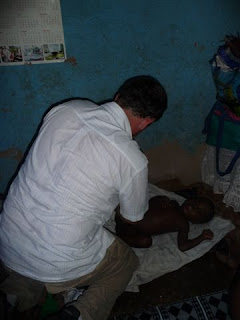
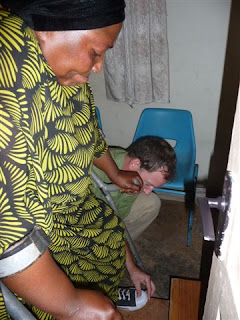
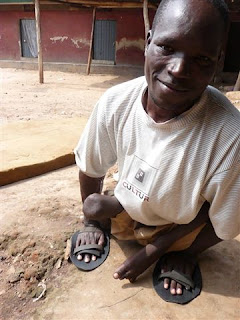
As I went out into the community, making house calls and visiting, I realized the extent of disability in the slum. Hidden in homes, carried on backs, sitting on stoops, people with disabilities were everywhere. Cerebral Palsy, malarial and congenital, drop foot from improper quinine injections, rickets, and trauma, leprosy and polio.
I knew that providing primary care to this ocean of disabled people as the only PT in the slum was not a sustainable approach, nor was KCCC addressing disability issues. However I didn’t know how to address something of this magnitude. So I started doing some research on the slowest internet connection known to man. I discovered 2 things: the first is that organizations have been addressing disability in Uganda since the mid 60’s, with some success. These programs focused on many aspects: advocacy, polio, leprocy, however, the majority of the organizations focused on children. Secondly, I learned about a rehabilitation concept adapted by the World Health Organization years back called Community Based Rehabilitation (CBR). CBR is a holistic approach to rehabilitation used where formal medical knowledge is lacking and medical infrastructure non-existent. The idea was to use a holistic approach whereby the community becomes empowered and educated to care for themselves. Since disability is more then disease, but a loss of function and ability to participate in the mainstream world, in parts of poverty stricken Africa, where inability meant death or life threatening burden to the community, CBR called on addressing disability from a cultural, economic, educational, and medical perspectives.I began to contact some of the organizations that dealt with disability in Uganda. I contacted and spoke with advocacy and educational associations, disability NGOs, the PT department at Mulago Hospital, Uganda’s referral center, the association for the blind and deaf. For every NGO or entity that I made contact with, many lead to dead ends.
Getting to understand CBR, I could see that KCCC was well positioned for such a comprehensive approach. We already had a successful micro-loan and income generation program in the form of a cooperative bank. We run a primary school and child counseling and advocacy, we have a medical clinic, a vocational training program, and most importantly, access to and trust of the community.
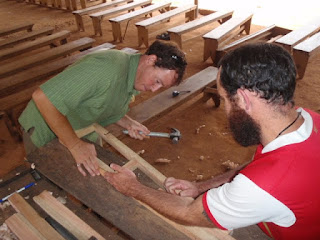
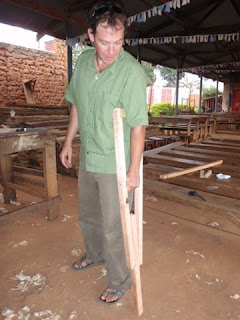
I began working at the vocational school, thinking that building adaptive equipment using local materials, and possibly training some of the staff and students was a good place to start. We built our first pair of crutches for less then $2, planing the wood ourselves the old fashioned way. I commissioned hand and knee paddles to be made as a prototype for use by people with polio who walk on their hands and knees. This generally produced the desired effect, interest from the staff and participation, curiosity at a new potential source of service, income as well as training and potential employment for students.
I also contacted 2 very promising leads; the first was a newly built surgical hospital called CoRSU, a well-staffed and well-funded orthopaedics and plastics hospital. CoRSU was pleased to make contact with KCCC, and after seeing Rusha and I on television after we ran the Buganda road race (if you didn’t read that blog entry, Rusha came in second, I limped along, but we both were interviewed on national television, which I think gave us some buy-in from people who saw us as famous mzungus) they were eager to partner with us. The most promising of partners was a place called Katalemwa Cheshire homes (KCH), a Ugandan NGO since the 60’s that provides comprehensive rehabilitation services in a CBR framework to children.
My idea was taking shape: I would train a small core group of KCCC staff who would become CBVs trained in the concepts of CBR and disability care and prevention. I would involve the different branches of KCCC, the bank, the vocational training center etc…for the holistic approach, and we would partner with KCH to provide rehabilitation services, education, and a new referral source for KCCC.
I pitched the idea to management, emphasizing that this approach is sustainable because most mechanisms were already in place, and that the main burden, that of rehabilitative care would fall on KCH while we would do what we already do best, community mobilization, sensitization, and using existing resources.
We chose a team from among our staff to become the CBR core group. These consisted of medical officers, nurses, counselors, teachers and CBHW. I lectured and we discussed various topics on a weekly basis (or whenever they showed up, or I was able to coerce them to come with the promise of soda): Disability concepts, advocacy, education and family training, diagnosis, pathophysiology, physical treatment, adaptive equipment and more. All at a very basic level, always emphasizing community sensitization, identification, and referral.
For a PT, or anyone for that matter, Uganda’s beliefs about disability are fascinating. Most people believe that disability and mental illness are punishment for a sin someone committed in a former life, or curse that was put on the family, or possibly Juju. Children are hidden in back rooms, under beds, and in bathrooms, never to be brought outside. Women are too proud of their womanhood to give birth at medical centers, giving birth in homes, in a pharmacy’s stock room, and paying the price when things go wrong. Disability and its cause are sometimes disease we in the West saw 100 or more years ago: Polio, Leprosy, Rickets, Cerebral malaria. We also saw post injection paralysis (Quinine, an anti-malarial, is injected directly into the sciatic nerve by an untrained person destroying the nerve and creating permanent foot drop), horrible and unnecessary trauma from accidents, osteomyelitis, and more.
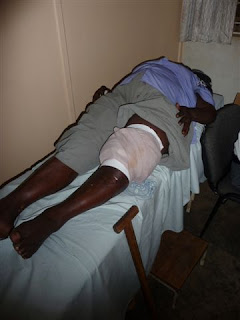
I continued to see patients once a week in my little PT clinic, using the few basic things I brought: McConnell and athletic tape, Elastic bandages, and an ice pack. Practicing was fun, and Africa allowed for some liberties. I could prescribe medicines or order x-rays. The cases were interesting and diverse, from devastating strokes, acute osteomyelitis and septic infections, to back pain, trauma, and paralysis. Some were appropriate. Others not, some we were able to treat with good results, others with no effect, however, all my patients were grateful for the effort.
Together with KCH, we hashed out a proposal that would benefit both organizations. KCH would provide us with education, access for our patients to their rehabilitation center and services. They would also provide our staff with training, help us with our CBR program, and most importantly, they would provide quarterly clinic days, where they would come to our community and provide assessment, education, diagnosis, referral, and treatment to children with disabilities. In return, we would provide them with community mobilization, a venue, access to our bank, and open our school to children with disabilities.
I believed the first clinic day would cement the CBR program. Not only would we tangibly provide rehabilitative services to the slum, but the CBR team would get a hands on training day with an experienced team, KCCC would see the benefits of the program, and the community would get the care they required, spurring them to press KCCC to maintain the program when I left and ensure continuity and sustainability.
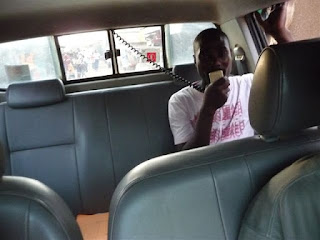
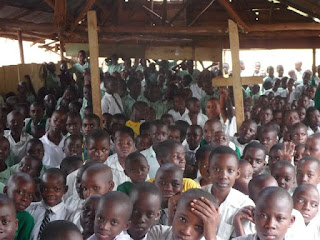
When clinic day came it went great. After a week of mobilizing the community by driving around the slum announcing the event by mega-phone on a pick-up, through community elders, word of mouth, schools, and the primary health clinic, the big day finally came. Despite heavy rain – an all-stopper in Uganda – 150 people came. We assessed 50 children with disabilities, providing diagnosis and referral and treatment. We tested and counseled 35 people for HIV. We had a full day of talks and demonstration, on saving and creating income, vocational training, disability awareness, and more. Both KCCC and KCH took notice of the turn out and the good organization and vowed to continue the relationship and help it grow. The community was thankful, and most importantly, children got much needed and deserved services.
My hope is that KCCC can sustain a basic CBR program. By sharing ideas, resources, and services, and creating a partnership whereby each partner brings what they are best at to the table. In this way, KCCC, with little investment and some basic training, can provide rehabilitative services to the community which it serves. In the end, like everything in life, I got the most out of the experience. As always, the intimate invitation to share a moment in someone’s life, and this time, someone as different from me as a slum-dwelling Ugandan, is what I cherish most, and the work in Uganda was some of the best I have had the opportunity to do in my life.

Wednesday, March 31, 2010

Ssemwange Mirazimu update

Remember the little boy with the hole in his skull? Ssemwanga Mirazimu? Well, before we get too far from Uganda and things get lost in the shuffle, i wanted to give an update about our little adopted boy.

I think the last time I wrote, he was sitting in Mulago hospital waiting for surgery and we had bought the supplies. This was back in January. There was a week delay from the original time we were supposed to show up because the operating room for the neurosurgeons, which are only available to them 2 days each week, was closed because a visiting team of cardiac surgeons were coming to the hospital. So, everyone was put on hold. We did get admitted, but unfortunately, during that hospital stay, after about a week, our boy was sent home from the hospital, actually, because he got a fever. I mean, why would a kid with a fever stay at a hospital to get treated?! He was told to return in one week's time, and after being treated for malaria by an outside clinic, we all trekked back to the hospital. When we arrived back, the pediatric neurosurgery ward was completely full with the aforementioned types of tragic patients, all waiting. This is the theme. I met mothers who had been there for 3-4 months, hopeing to at some point get a chance to be operated on. The problem is, the docs are only there a few hours each day (because they are otherwise at their private practices that actually pay them money) and the operating room time is so infrequent and the neurosurgery cases can be so long that only 1 or 2 kids get operated on in a day. Then there are the emergencies. Given that Mulago hospital is the only referral center for a country of 30 million people, it begins to make sense why so many are just sitting around.

The long and the short of it is that we were not admitted the next time we showed up. The ward was full. The nurses balked. My doctor friend (the surgeon) was willing to squeeze him in, but his partners were upset and when push came to shove, when I finally confronted them, it became clear that the surgery was never going to happen there. Our kid has a big problem, yes, but he is healthy, he is not in any acute danger, and he could not just jump the line of those who had been sitting for weeks. For many reasons, this would not work.
All this took several hours to sort out, up and down stairs from the ward to the clinic, talking to all the doctors on the team, being as graciously pushy as I could. But we were not finished. I was not about to give up...
Our surgeon, Dr. Kiriabwire, who had become my go-to person and seemed to be responding to professional courtesy and praise, thought that there might be a plan B when I asked if there was ANYTHING else we could do. He said he would contact the hospital where he has his private practice, International Hospital of Kampala (IHK), to see if there as any way to do the surgery as a charity case. We had a few more weeks of phone contact (ie, Rusha calls every few days to politely ask how things are going) and lo and behold, he said that his partners were in agreement that they could do the surgery at IHK!
The last week of our time in Uganda, really drawing it out to the very end, Ssemwanga and his mommy Sarah and I met at the taxi park in downtown Kamapala, easily the craziest, most crowded place I have ever been in my life. We found eachother and made our way to this fancy private hospital. Sarah could not believe how organized the place was: you registered and had a card with your name that could be found again, you were sent to a triage area to get vitals done, you met with a doctor who did a basic history and physical, you got labs done right there, and finally you went to the ward. We were put on the Hope Ward, a place for the hospital to care for patients who would otherwise not be able to afford their care. The hospital was quite modern with nurses on the floor full-time (unlike in Mulago where no one is there at night) and the capacity to take vitals, meals for the patients, bedsheets and clean bathrooms, doctors on call and reachable should anything happen... She was in total disbelief and was obviously uncomfortable in that environment. She had spent the only money she had to get her hair done before the hospital stay--one cannot show up at such a place without a new hairstyle! After a full day of logistics, we established that the surgery would take place on Saturday (the day before we were leaving for the west of Uganda) and I left Sarah to wait for a day. She did not want me to go and called often to ask for help. One time, when I asked he what was wrong, she said that she needed sugar for her tea. I fear I created a bit of a dependency problem. (She also asked if Guy and I could pay for the school fees of her other boy.)
So, the story ends happily. The surgery actually did happen. I swear, we were not sure it would until it did. We got a nice gift for Dr. Kiriabwire and we went to see him post-op and it was really one of the best overall experiences I had in Uganda. To see something through and have it work was so rewarding and rare. It will be hard to follow up on this guy. I talked to the mom, Sarah, on the phone from western Uganda and found that he was home and had already had a follow up with the surgeon and that all was well. She has no email and wanted my phone number in the US, but hopefully through some of our friends at the clinic at KCCC, we can follow her a bit and see how she and Ssemwanga are doing. He will not remember much, but we hope that this helps him to grow up and have a full life.

Monday, March 22, 2010

Bwindi impenetrable Forest, the Mountain Gorillas and Lake Bunyoni


After a well deserved and well needed night of sleep in Kasese, we re-packed our now lighter back packs and set out for 160 km trip to the southwest of Uganda, and Bwindi Impenetrable Forest. We decided to take the "long way" which took us through the heart of Queen Elizabeth National Park. After the usual Ugandan delays of waiting for a taxi etc... we finally arrived at an intersection with the main road and the Ishasha road which is a 100 km dirt road through the middle of no-where. As we arrived, a car packed to the hilt, topped by mattresses,bags and chickens was getting ready to leave. However, when the driver saw two Mzungus reaching his intersection, his face lit up with dollar signs and he approached us. We haggled for a price, knowing that on this remote road, on a Sunday, this may be our only chance to cross to the other side of the park. Then not knowing where he was going to fit us and our big bags into an already overstuffed shit-box, he told us to get in. There were already 8 people and a baby in the car, we made it 10!Two people were in the driver seat, 2 in the passenger seat (and a baby) and 4 people sat across the back seat, with 2 grown adults on the passengers laps. All this in a small Toyota sedan! This may have been the worst ride of our lives: 3.5 hours of dirt road in the midst of a stench of humanity that is uniquely African. We eventually arrived in Buhoma, our destination after a day of traveling and spent 2 days recovering, doing laundry, popping foot blisters and resting up for the next leg of the trip, which was to be a walk through Bwindi Impenetrable Forest NP. The park was established on the border of DR Congo to protect the mountain Gorillas, a group of about 700 animals left in the world that live in this park and another one..


On a clear morning, we met our guide/owner of the walking safari Asgario and, after the usual fee/guard/tip/checkpoint fee/NP fee/Walking fee/breathing fee... we set off to cross Bwindi NP from the north to the west walking 10 km in a beautiful primary rain forest. We saw blue, Colobus and vervet monkeys and some rainforest fauna.
We emerged on the other side and climbed a substantial hill through the farmland that starts within feet of the park borders and crested to the village of Nkoringo, where we spent the night. The hilltop camp where we stayed had stunning views of Bwindi to the north, and the Verunga volcanoes on the border with Rwanda to the south. We went to sleep in great anticipation of the next morning, when were to track the Nshongi gorillas, one of 4 gorilla groups in the Bwindi park.

We awoke early in the morning, broke camp, and headed to Nshongi. The mountain gorillas, made famous by the movie "Gorillas In The Mist", number about 700 in all, and are divided among several groups in Rwanda, Uganda, and DRC. About 5 of these families are habituated in Bwindi, and can be tracked by and interact with people. The gorillas exist only in these 3 parks, and so intensive efforts have been undertaken to secure their home environment, including the relocation of the Batwa pygmie peoples from the forest. The gorillas are tracked by sending scouts ahead to follow the path of leafy destruction they leave after their previous night’s nest. They rarely move more than a km or so a day. After a short briefing we walked to the forest's edge, and after 45 minutes, and barely into the primary forest, we came upon the gorillas. Our first sighting was a big silverback, the dominant male of the group, pickily eating marion fruit and farting. Slowly we encountered gorilla after gorilla, most lazily sitting, totally surrounding themselves with yummy vegetation, gorging themselves. Ohers were in trees. All were eating.

The group had 2 silverbacks, some new babies and all in all about 35 members. We spent an hour with the critters, which is all one is allowed. Sometimes, the views of the animals were amazing, being only 3-4 meters from the great apes. Mostly, though, it was through thick brush, or up in trees, or on the move. As someone said, you get to see lots of gorilla butts up in trees. The hour went by fast and it was time to leave and say goodbye.
The experience was interesting, and when you look into their faces and eyes, they do look like hairier version of us, however, in the long run, both Rusha and I thought that it was a bit over-rated at $500 per person for 1 hour. While you get to watch them closely and intimately, there is no real interaction with them and they could care less that you are there—you could almost be just another tree.

Our next destination was Lake Bunyonyi, landlocked amidst the fertile and steep hills of southwestern Uganda and bordering Rwanda. This is Uganda's deepest lake, and rumored to be the only Bilharzia-free water (we hope so). We arrived and stayed at a beautiful lakeshore camp that caters to overlanders - trucks of youngsters, heading across the African continent in an open air truck, stopping along to see the sights, usually from Cairo all the way to Cape town in South Africa.The camp was beautiful and manicured, with nice food and docks, and dugout, left-turn-only canoes. It even had an 8 meter high platform to jump into the lake from! We sunned ourselves, ate crayfish from the lake and hung out in the local market, to which farmers bring their wares in canoes from across the lake. We rested, swam, ate, and drank after the many kilometers of walking the week before.

To get back, we took a very long bus ride back to Kampala, during which the incidents included a bit of mob justice on a man who crossed the road on his bike in front of our careening bus, and almost caused an accident. Men from the bus jumped out, caught the poor guy, and whipped him with branches and punched him a few times. This is justice in the bush and I bet that guy will never anything like that again. After running a girls foot over on the way into Kampala (really the bus ran over her foot!) we arrived safely in Kampala where we spent a couple of days frantically packing, saying our goodbyes, and enjoying some decent food and coffee after 2 weeks of bush coffee and chicken and chips.

Our time in Uganda has been amazing, and a growing experience. We have met unique and wonderful people and friends, seen amazing things, and heard and experienced amazing stories. Uganda, you will be missed!

We are off to Nairobi, to climb Mt Kenya. After that we are on to Cairo, and then overland, via Jordan to Israel. We will keep every one up to date as often as we can, thanks for coming along with us on this journey.

Mwebale Nyo (Thank you very much)

Wednesday, March 17, 2010

The Rwenzori Mountains


Our first adventure as fully unemployed travelers was to head west from Kampala to the border of Uganda and the Democratic Republic of Congo to hike in some of the most remote mountains in the world, the Rwenzoris (the Mountains of the Moon.) The Rwenzoris house the highest non-volcanic peak in Africa and the 3rd highest peak overall, Margherita Peak on Mt Stanley. The Rwenzoris have been in a conflict zone for so much of the past 30 years that they have very little traffic and these days see about 500 visitors each year, making them extremely isolated and untouched and pristine. We signed up to do the “Central Circuit” which is a 6 or 7 day hut-to-hut trek that follows two rivers, the Bukjuku and Mobuku Rivers, in a circuit that passes below the 3 highest massifs in the range. As with most East African expeditions, a guide and porters are required and we met up with Peter, our guide, who has been taking clients into the Rwenzoris since 1971, and our 3 porters: Matthew, Gideon and Bonfast. Peter is from the Bakonjo tribe, the people who are native to the Rwenzori mountains, and while he is a bit past his prime, at 48 years old, he rocked the hike and put us to shame on the downhills.


The hike starts at the village of Nyakalengija at an elevation of about 1000 meters and climbs from there. The hike is a trek between huts that are 7-8 km apart, but covers elevation gain and terrain that make the distances seem far more challenging. Most of the hike is through bog, which if you haven’t encountered it, is thick mud, up to your knees or even thighs, that must be negotiated by walking on logs that have been placed in it, or by hopping from tussock pads or patches of grass, or basically anything that can keep you out of the deep mud. The mud us negotiated in rubber boots and waterproof pants and if you happen to land in the mud, you have to be very careful to keep your boot on.


Day 1 climbs 1600 meters of vertical and put us at the start of the circuit, a hut called Nyabitaba. On that first day we got our first glimpse of the intense greenery that can only come from one of the wettest places in the world, the Congo basin. The flora is enormous and moisture is everywhere, hanging on the leaves of huge, broad-leafed plants.


Day 2 is an introduction to the bog. After crossing the Bujuku River, we slogged uphill to 3500 meters, crossing kilometers of wet, sludgy, bog and neon green carpets of moss. If you didn’t get a walking stick at the start (as Guy did not,) your balance is truly put to the test as you negotiate little branches and rocks in the mud in order to progress. On the second night we slept at a hut that allows the first views of the glaciated peak of Mt Stanley as the clouds cleared for some minutes before dusk.

Day 3 we entered the surreal landscape of the Rwenzoris, walking through thigh-deep mud and little tussock hills (grass mounds that offer a chance to hop and avoid the mud,) the plants are unlike any we have ever seen and are endemic only to this range: purple cactus-like plants and bizarre trees. We were supposed to stop at the Bujuku hut, but we asked our guide if we could instead divert to the highest hut, Elena hut, that also happens to be the staging ground for climbing the highest peak in the range, and he obliged. So we trudged straight uphill to 4550 meters (about 15,000 ft) thankfully leaving the bog behind and entering a range of boulders, rocks, and sheer cliff faces at the base of the Stanley glacier. Now, here is where Africa works well: our guide, seeing our strength and interest in the peaks and Guy’s particular interest in mountaineering, suggested that if we were to compensate him appropriately, he would lead us up to Margherita Peak, the highest point in the mountains. We gladly obliged. We had been paralleling our hike with a couple who had plans to climb Marghertia Peak all along. Our job was to convince them that they wanted us to join them on their summit ascent and share their rope; our guide Peter’s job was to convince the other guide, who happened to be his nephew, that he wanted to share the equipment with us. Luckily, our hut-mates were

game for us to accompany them.


Day 4 started after a mostly-sleepless night of nausea and headaches due to the altitude, we were up at 4 am to attempt the peak. After several hours of hiking to reach the base of the first glacier, we roped up and put on whatever motley equipment

was leftover: Guy had a homemade harness and Rusha had ill-fitting crampons. Our guide was missing both and was hiking the glacier i

n rubber gumboots and a walking stick. Thankfully this sketchy situation was ameliorated after our companions decided to turn back after a semi-technical down-climb, and we were lucky enough to continue with their equipment: ice axes, crampons, harness, and rope. Our guide also got sunglasses from the other guide which made his life much nicer and made us feel safer that he could actually see. We proceeded to climb 2000 vertical feet on a crevasse-strewn glacier, then a short technical rock climb and summited 16,763 ft margherita peak (5109 m) in the clouds and gale-force winds, with enough time to document the moment and revel in our accomplishment: the highest Rusha has been in her life and the highest non-volcanic peak in Africa. We finished the day by returning to the hut and descending to Kitandara hut, at a much nicer elevation of 4000 meters to rest up.

Day 5 started with a climb to 4300 m (the highest point on the central circuit) and then descended steeply to a hut at 3900 meters, Guy Yeoman hut. We enjoyed not suffering from headaches or nausea but Rusha managed to touch some plant that caused her to have a major allergic reaction with some angioedema. Luckily the reaction was limited to eye and lip swelling and was improved with some Benadryl and Prednisone in the trusty first-aid kit.

Day 6, our last day, was an amazing amount of downhill. We dropped 2500 vertical meters (about 8000 feet!) Most of it was clambering over the usual Rwenzori terrain of rocks, roots, bog, and mud. It was steep and directly straight down. After several doses of Alleve we arrived back at our starting point in the village where we said our goodbyes to our group of porters and guide and hopped on bodas down to the town of Kasese, where we took our first shower in a week and fell exhausted into a real bed. The next day we left for Buhoma, the entrance to Bwindi Impenetrable Forest where we were to track the mountain gorillas.